
“Why am I not losing weight” — this is probably the most frustrating question a woman can ask herself. You eat less than ever. Some days barely anything. The scale hasn’t moved in weeks. And if anything, you feel worse than when you started.
Here’s the thing nobody tells you upfront: eating too little can be exactly why you’re not losing weight. Not because you’re doing something wrong morally. Because your body is doing something right — biologically.

Your body doesn’t know you’re on a diet
When you drop your calories dramatically — say, to 1,000 or 800 a day — your body doesn’t think “great, she’s trying to lose weight.” It thinks there’s a food shortage. And it responds the way humans have been responding to food shortages for hundreds of thousands of years: it slows everything down to survive.
Your metabolism drops. Your body temperature lowers slightly. You feel cold, tired, foggy. Your hunger hormones spike. Your fat stores get protected — because in a genuine shortage, fat is the last thing your body wants to give up. It would rather burn muscle first, because muscle is metabolically expensive to maintain. So you lose muscle, your resting calorie burn drops further, and the fat stays put.
Scientists call this metabolic adaptation. A landmark study published in Obesity followed contestants from The Biggest Loser six years after the show ended. Despite having regained much of their weight, their metabolisms were still suppressed by an average of 500 calories per day compared to what their body size would predict — a direct result of the extreme restriction they had maintained. Their bodies adapted down and largely stayed there.
This isn’t a rare edge case. It happens to a degree in anyone who restricts too aggressively for too long. The scale stops moving. Not because nothing is happening — but because your body got very good at surviving on very little.
It’s not just how much you eat — it’s what you’re feeding your body
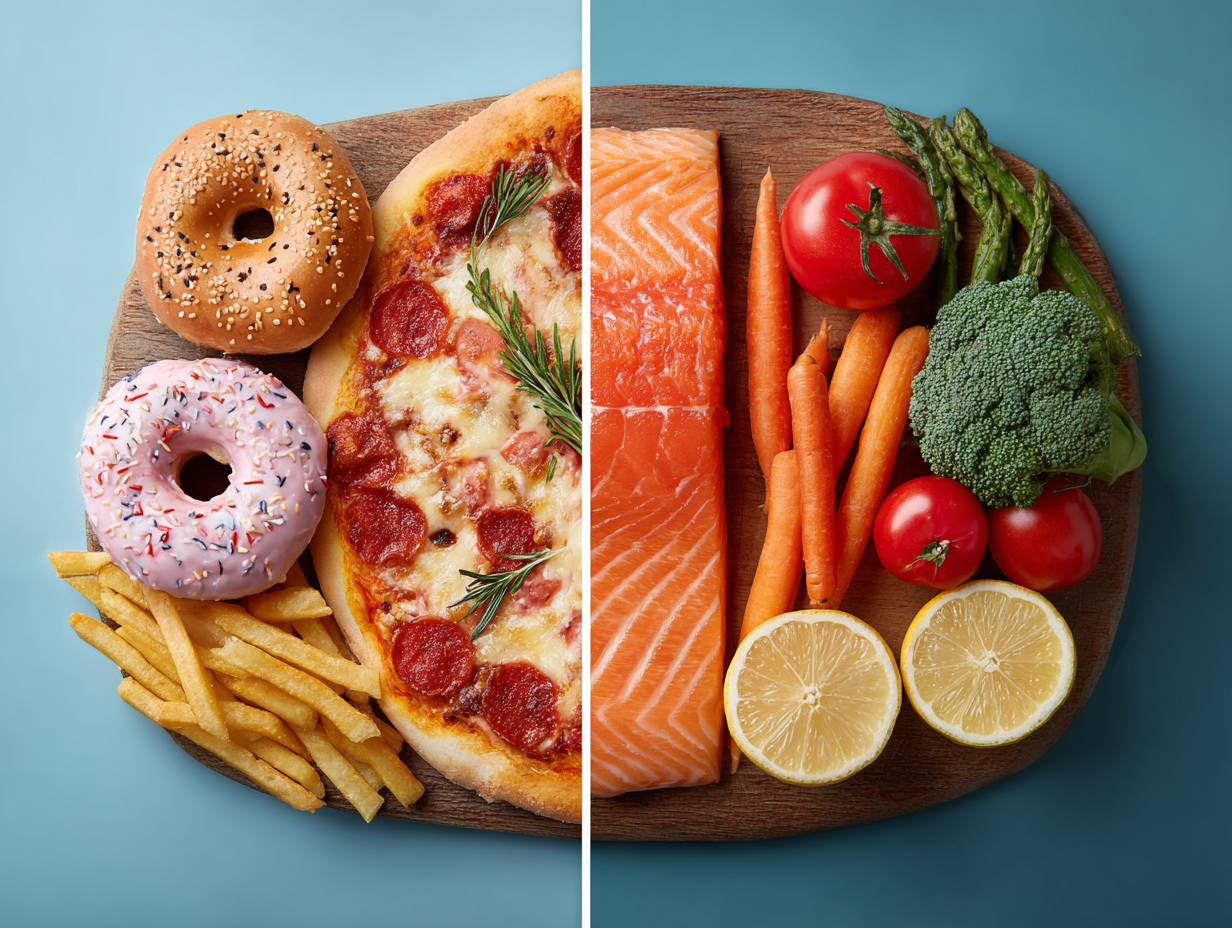
Two plates of food can have identical calorie counts and produce completely different results in the body. 1,500 calories of ultra-processed food — white bread, packaged snacks, sugary drinks — spikes blood sugar, crashes it again two hours later, drives hunger, and gives your body almost none of the micronutrients it needs to run properly. 1,500 calories of protein, vegetables, healthy fats, and complex carbs keeps blood sugar stable, feeds your gut bacteria, supports hormonal balance, and keeps you full for hours.
Your body composition isn’t determined by a calorie number alone. It’s shaped by your overall eating pattern — what you eat consistently over weeks and months. A balanced plate with adequate protein, fiber, and whole food sources keeps your metabolism working, your hormones balanced, your blood sugar stable. Strip those away in the pursuit of a lower number and you’re running the engine on bad fuel, then wondering why it keeps breaking down.

What eating 1,000 calories actually does to your body
Very low calorie intake — around 800–1,000 kcal a day — sets off a predictable chain of events:
- Your body doesn’t get enough vitamins and minerals to support basic enzyme function
- It reads the deficit as a genuine threat — a starvation signal
- Metabolism slows as an adaptive response to conserve energy
- Fat stores get locked — your body prioritizes keeping them as an energy reserve for the crisis it thinks is happening
- Muscle tissue breaks down instead — because it’s easier to burn and cheaper to lose
The result: the scale doesn’t move, or moves for a week and then stops completely. You feel exhausted. You’re cold all the time. Your hair starts falling out. Your period becomes irregular or disappears. And you’re hungrier than you’ve ever been — not because you’re weak, but because your hunger hormones are doing exactly what they evolved to do when food is scarce.
All of this while eating almost nothing. If you’re asking why am I not losing weight despite barely eating — this is the answer. That’s not a diet working. That’s a body in crisis.

Then add stress — and the picture gets worse
Chronic stress is the variable that most calorie advice completely ignores. When you’re stressed — really stressed, not just “had a busy day” but the ongoing background hum of too much work, not enough sleep, financial pressure, emotional load — your body runs on elevated cortisol.
Cortisol’s job is to prepare you for threat. One of the ways it does this is by signalling your body to store fat — particularly around the belly, where it can be mobilized quickly in an emergency. At the same time, cortisol drives cravings for calorie-dense food (your body wants fast energy for the perceived crisis) and impairs the part of your brain that makes deliberate choices. This is why stress eating isn’t a character flaw. It’s your nervous system running a program that made complete sense 50,000 years ago.
A calorie deficit on top of chronic stress almost never works. Your cortisol is already telling your body to hold onto fat. Restricting heavily adds another stressor on top. The body doubles down on protection. A 2001 study published in Psychoneuroendocrinology found that women with higher cortisol reactivity consumed significantly more calories after stressful events — not from hunger, but from reward-seeking behavior driven by the stress response itself.
You can’t out-restrict a nervous system that’s stuck in survival mode.
Your body responds to the quality of what you eat — not just the quantity
This is the shift that changes everything. Your body isn’t a calculator. It doesn’t just count calories in and calories out and produce a neat result. It responds to signals — hormonal signals, gut signals, blood sugar signals, stress signals — and makes decisions about fat storage and fat burning based on all of them.
Feed it consistently with balanced meals — adequate protein, plenty of fiber from vegetables and whole grains, healthy fats, enough micronutrients — and it runs cleanly. Metabolism stays up. Blood sugar stays stable. Hunger is manageable. Hormones function. Fat burns as it should.
Restrict it below what it needs, fill it with processed food that spikes and crashes blood sugar, add chronic stress, and sleep badly — and none of the calorie math matters anymore. The body finds ways to compensate, protect, and hold on.
What you eat consistently over weeks and months determines whether your body is in fat-burning mode or fat-storage mode. A tight deficit with terrible food quality, high stress, and poor sleep puts it firmly in the second category — even if the number looks right on paper.
So why am I not losing weight — and what actually fixes it?
A moderate calorie deficit — not a brutal one. Around 200–300 calories below your maintenance, not 800. Enough to create a slow, steady fat loss that your body doesn’t panic about. Enough to keep hunger manageable and hormones stable. Slow enough to preserve muscle, which protects your metabolism long-term.
High protein at every meal — because protein protects muscle during a deficit, keeps you fuller for longer, and costs more calories just to digest. Real food that your body can actually use — vegetables, whole grains, legumes, eggs, meat, fish, dairy. Not perfect, not obsessive — just consistently good enough that your body has what it needs to function.
And attention to the things outside the plate: sleep, stress, movement throughout the day. These aren’t extras. They’re part of the system. A body that sleeps 7–9 hours and has a manageable stress load loses fat on a moderate deficit. A body running on 5 hours and chronic cortisol holds onto fat even on a significant one.
We’ve also covered the mechanics of this in detail in our article on calorie deficit for women — including exactly how big the deficit should be, why aggressive restriction backfires, and how to eat in one without being hungry all the time.
THE levik app
Find out exactly how much you should actually be eating
Not 1,200. Not a guess from the internet. LEVIK app calculates your personal deficit based on your body, weight, and activity — then builds your full day of meals around that number automatically. Free to use.
The takeaway
If you’re eating very little and not losing weight, your body isn’t broken and you’re not failing. You’re experiencing a completely predictable biological response to under-eating — one that’s been documented in research for decades and felt by millions of women who were told to simply eat less and try harder.
Eating less than your body needs doesn’t accelerate fat loss. It triggers a protection response that blocks it. The answer isn’t to eat even less. It’s to eat the right amount — consistently, with real food, in a way your body doesn’t experience as a threat.
That’s not a compromise. That’s just how it actually works.
THE LEVIK COOKBOOK
Eat enough. Lose weight anyway.
The cookbook calculates your real calorie target — not 1,200, not a guess — and builds your full day of meals around it automatically. Real food that fits your deficit without starving yourself.
Sources
- Fothergill E, et al. Persistent metabolic adaptation 6 years after “The Biggest Loser” competition. Obesity, 2016. pubmed.ncbi.nlm.nih.gov
- Leibel RL, et al. Changes in Energy Expenditure Resulting from Altered Body Weight. New England Journal of Medicine, 1995. pubmed.ncbi.nlm.nih.gov
- Nedeltcheva AV, et al. Insufficient sleep undermines dietary efforts to reduce adiposity. Annals of Internal Medicine, 2010. pubmed.ncbi.nlm.nih.gov
- Epel ES, et al. Stress may add bite to appetite in women: a laboratory study of stress-induced cortisol and eating behavior. Psychoneuroendocrinology, 2001. pubmed.ncbi.nlm.nih.gov
- Stiegler P, Cunliffe A. The Role of Diet and Exercise for the Maintenance of Fat-Free Mass and Resting Metabolic Rate During Weight Loss. Sports Medicine, 2006. pubmed.ncbi.nlm.nih.gov
- Leidy HJ, et al. The role of protein in weight loss and maintenance. American Journal of Clinical Nutrition, 2015. pubmed.ncbi.nlm.nih.gov
- Hall KD, et al. Energy expenditure and body composition changes after an isocaloric ketogenic diet in overweight and obese men. American Journal of Clinical Nutrition, 2016. pubmed.ncbi.nlm.nih.gov
This article is for informational purposes only and is not a substitute for professional medical or nutritional advice. If you have concerns about your weight, metabolism, or eating habits, please consult a qualified healthcare provider or registered dietitian.