


A calorie deficit for women is one of those concepts that sounds simple on paper and feels brutal in practice. You eat less than you burn, your body uses stored fat for energy, you lose weight. That’s the whole mechanism — and it genuinely works. Every diet that has ever produced fat loss has done so through this exact process, whether the person knew it or not.
The problem isn’t understanding the concept. The problem is that most people approach it in a way that’s almost guaranteed to fail — either because the deficit is too large, the approach is too rigid, or nobody explained the parts that actually make it liveable.
This article covers all of it: what a calorie deficit actually is, how to find your specific number, how big it should be, what happens when it’s too aggressive, and — most importantly — how to eat in one without being hungry and miserable the whole time.

What a calorie deficit actually means
Your body needs a certain amount of energy every day just to function — to keep your heart beating, your lungs breathing, your brain thinking, your cells repairing. On top of that, it needs energy for everything you do: walking, working, exercising, digesting food.
The total amount of energy your body uses in a day is called your maintenance calories — or more technically, your Total Daily Energy Expenditure (TDEE). It’s the number of calories at which your weight stays completely stable. Eat exactly that amount, and nothing changes. Eat more, and your body stores the surplus as fat. Eat less, and your body has to find the missing energy somewhere — which it does by burning stored fat.
That gap between what you eat and what you burn is the calorie deficit. If your body needs 2,000 calories to maintain your weight and you eat 1,700, you’re in a 300-calorie deficit. Your body makes up that 300 calories by pulling from fat stores. Do that consistently over weeks and months, and the fat stores decrease — which is what we call weight loss.
There is no other mechanism for fat loss. Intermittent fasting, low-carb, keto, Mediterranean, plant-based — all of these produce fat loss when they work because they put you in a calorie deficit, either directly or indirectly. The diet is the vehicle. The deficit is the engine.
How to find your maintenance calories
Before you can eat in a deficit, you need to know what your maintenance number actually is. This varies significantly between women depending on height, weight, age, and — most importantly — how active you are.
The most accurate formula for estimating it is the Mifflin-St Jeor equation, which a 2005 review in the Journal of the American Dietetic Association identified as the most reliable for most people. You don’t need to do the math manually — our free SmartBite calculator does it for you: enter your details, get your personal calorie target, and get a ready-made meal plan built around your deficit. But it’s worth understanding what goes into the number.
The formula first calculates your resting metabolism — how many calories your body burns just keeping you alive with zero movement. For most women, this alone accounts for 60–70% of total daily calorie needs. We covered this in detail in our article on calories for women at 30, including worked examples at different heights and weights.
Then you multiply by an activity factor:
- Mostly sedentary (desk job, little exercise): × 1.2
- Lightly active (light exercise 1–3 days/week): × 1.375
- Moderately active (exercise 3–5 days/week): × 1.55
- Very active (hard exercise 6–7 days/week): × 1.725
The result is your maintenance number — the calories that keep your weight stable. Everything else is calculated from here.
One important note: be honest about your activity level. Most people overestimate how active they are. “Going to the gym three times a week” sounds like moderately active, but if you sit at a desk for 9 hours otherwise, you’re closer to lightly active. Using an inflated activity multiplier gives you a higher maintenance number — you create a smaller deficit than you think and wonder why the scale doesn’t move.
How big should your calorie deficit be?
This is the question that most diet advice gets wrong — usually by recommending a deficit that’s far too large.
One kilogram of body fat stores about 7,700 calories of energy. This means:
- A 200–300 calorie daily deficit → roughly 0.2–0.3 kg of fat loss per week
- A 500 calorie daily deficit → roughly 0.5 kg of fat loss per week
- A 1,000+ calorie daily deficit → roughly 1 kg per week — but this is where things go wrong
The bigger the deficit, the faster the loss — in theory. In practice, large deficits trigger a cascade of biological responses that work directly against you.
Your body doesn’t distinguish between intentional dieting and actual starvation. When calories drop sharply, it responds the same way it would to a food shortage: it slows your metabolism, increases hunger hormones, decreases fullness hormones, and begins breaking down muscle tissue alongside fat for fuel. A 2010 study published in the Annals of Internal Medicine found that people in a larger deficit lost significantly more muscle mass than those in a moderate deficit — even when protein intake was the same. Less muscle means a permanently lower resting calorie burn, which makes maintaining weight loss harder after you stop dieting.
The practical sweet spot, backed by the most consistent body of research, is a deficit of 200–500 calories per day — closer to 200–300 if you’re already relatively lean, closer to 400–500 if you have more to lose. This produces slow, steady fat loss that your body doesn’t panic about, preserves muscle, keeps hunger manageable, and is realistic enough to sustain for months rather than weeks.
How slow is too slow? It depends on your starting point, but 0.3–0.5 kg per week is considered a healthy and sustainable rate for most women. That’s roughly 1.5–2 kg per month. It doesn’t feel dramatic. But over six months, that’s 9–12 kg — results that actually last, because you lost fat rather than muscle and didn’t have to destroy your relationship with food to get there.

What happens when the deficit is too aggressive
Most women who have struggled with dieting have experienced this pattern: you cut calories hard, lose weight quickly for the first couple of weeks, then hit a wall. The scale stops moving. You feel exhausted. You’re thinking about food constantly. One day you eat everything in sight, feel terrible about it, and start over.
This isn’t a willpower failure. It’s a biological response to under-eating — and understanding it makes it much less personal.
When you eat significantly below your needs, several things happen at once. Leptin — the hormone that signals fullness and satisfaction — drops. Ghrelin — the hormone that drives hunger — rises. Your thyroid slows down slightly to conserve energy. Your body temperature drops. Your energy for non-essential activities (movement, socializing, focus) is quietly reduced to protect vital functions. You feel cold, foggy, tired, and hungry — not because you’re weak, but because your body is functioning exactly as it evolved to.
The research calls this metabolic adaptation. A landmark study by Dr. Kevin Hall, published in Obesity in 2016, tracked contestants from The Biggest Loser six years after the show. Despite having regained significant weight, their metabolisms remained suppressed by an average of 500 calories per day compared to what would be predicted for their body size — a direct result of the extreme deficits they had maintained during the show. Their bodies had adapted downward and largely stayed there.
This is why crash dieting doesn’t just fail in the short term — it can make future weight management harder by permanently altering your metabolic baseline. A moderate deficit, maintained consistently over time, avoids triggering this response.

The most important thing inside your deficit: protein
Once you know your calorie target, the single most important thing is how much of those calories comes from protein. This matters more than the carb-to-fat ratio, more than meal timing, more than most other nutritional variables.
Protein does three specific things that are especially important when you’re eating at a deficit:
It protects your muscle. When you’re in a calorie deficit, your body needs to find energy somewhere. If protein is abundant, it preferentially burns fat. If protein is low, it burns muscle alongside fat. Losing muscle reduces your resting metabolism and changes your body composition in ways that don’t look or feel good — and makes it harder to maintain results. A 2018 meta-analysis in the British Journal of Sports Medicine found that higher protein intake during a deficit was consistently associated with better muscle retention regardless of training status.
It keeps you fuller for longer. Protein is the most satiating macronutrient. It triggers stronger fullness signals than carbohydrates or fat, and it keeps hunger suppressed for longer after a meal. A high-protein diet in a deficit doesn’t feel like a diet in the same way a low-protein one does — the hunger is simply less constant.
It burns more calories just to digest. Your body uses about 20–30% of protein’s calories just breaking it down — compared to 5–10% for carbs and 0–3% for fat. This “thermic effect” means that every gram of protein you eat delivers slightly fewer net calories than it appears to on the label, giving a small but real metabolic advantage.
The target: 1.6–2 g of protein per kg of body weight per day while in a deficit. For a 65 kg woman, that’s 104–130 g daily. In real food terms: chicken breast (30 g per breast), Greek yogurt (17 g per 200 g), eggs (6 g each), cottage cheese (14 g per 100 g), lentils (18 g per 200 g cooked), tinned tuna (25 g per small tin). Three meals built around a protein source and you’re close.

How to actually eat in a deficit without feeling deprived
This is the part most calorie deficit guides skip — and it’s the part that determines whether you actually stick to it.
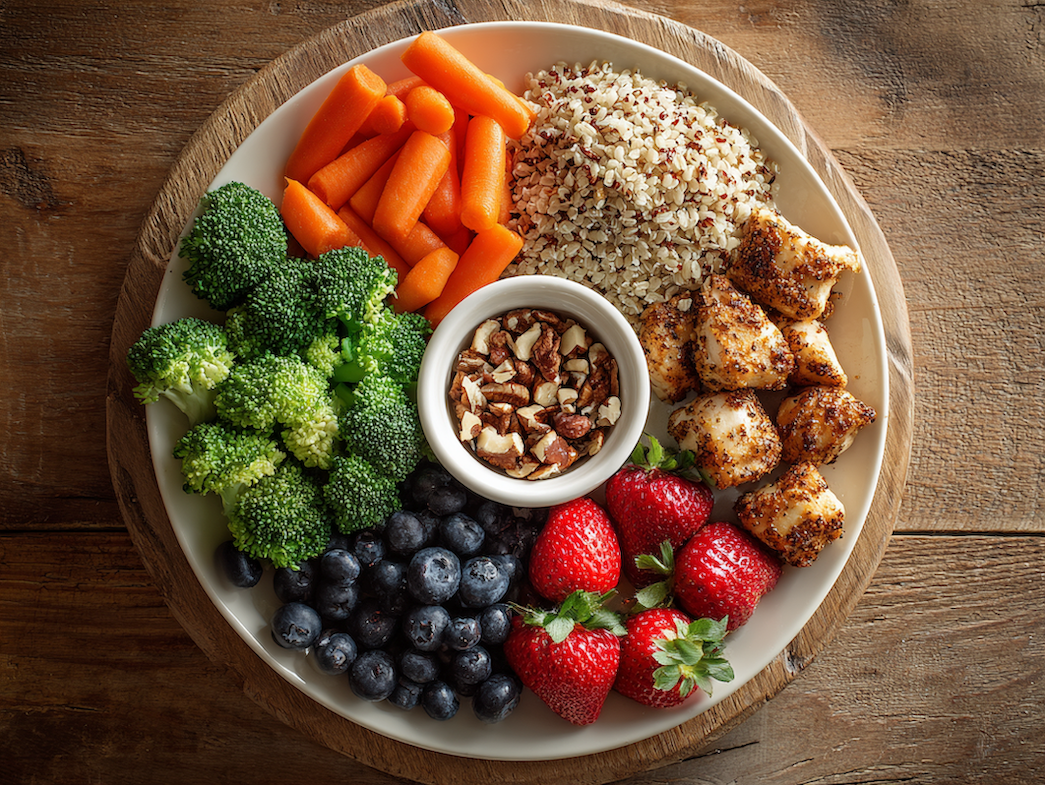
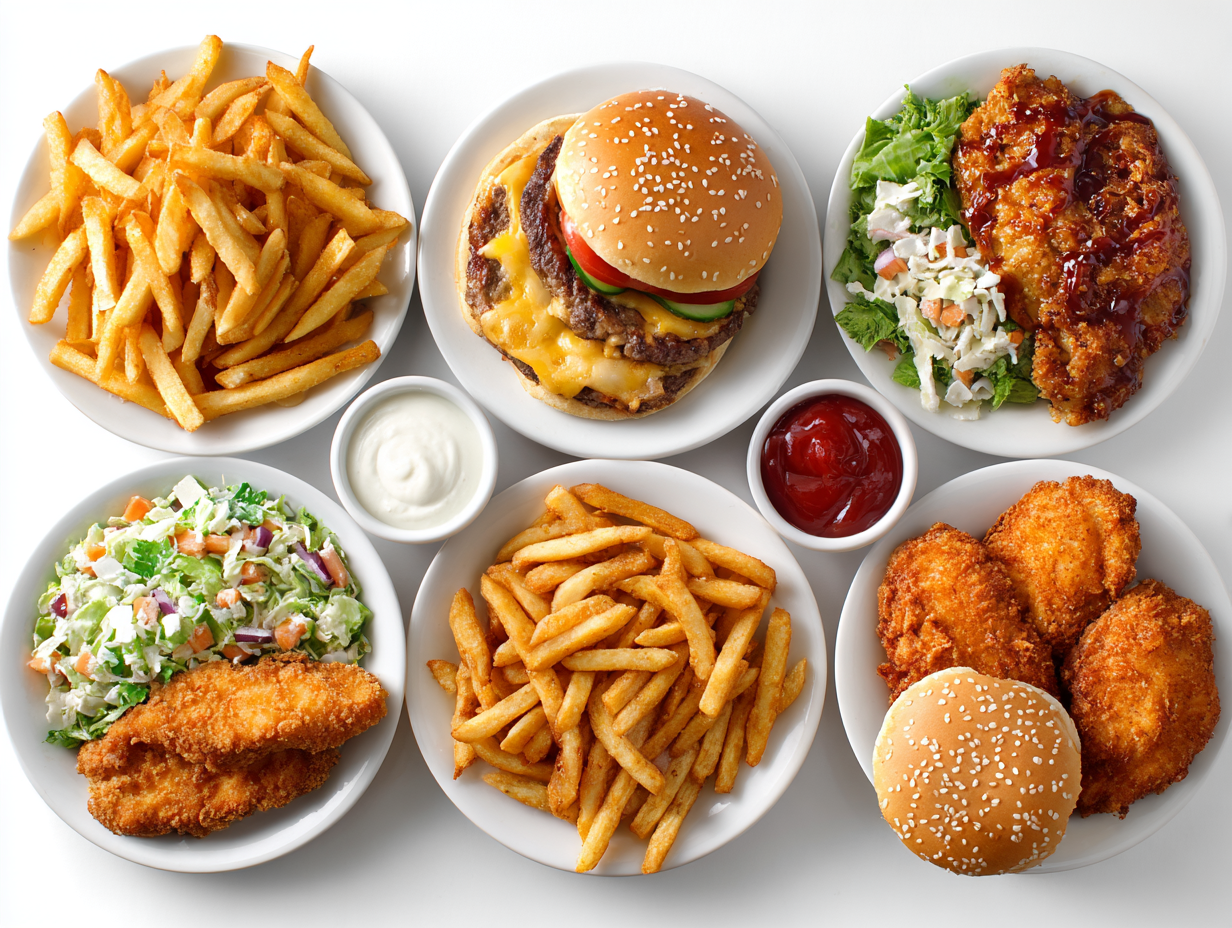
Volume eating: eat more food, not less. 300 calories of almonds is a small handful — maybe 30 nuts. 300 calories of chicken breast, roasted vegetables, and a small bowl of rice is an entire meal. The total calorie count is identical; the difference in how full you feel is enormous. Vegetables, lean protein, legumes, and whole grains are all high-volume, high-satiety foods that take up physical space in your stomach and trigger fullness signals. Ultra-processed foods and calorie-dense snacks do the opposite — they pack calories into small portions without filling you up. Building your meals around high-volume foods is the single most practical way to eat less without feeling like you’re eating less.
Protein at every meal — not just dinner. Most people eat most of their daily protein at dinner. The problem is that hunger and cravings build through the day when protein is absent from breakfast and lunch. Starting each meal with a protein source — eggs or Greek yogurt at breakfast, chicken or legumes at lunch — keeps hunger from spiking in the afternoon and evening, which is when most deficit-breaking tends to happen.
Don’t drink your calories. Liquid calories — juice, smoothies, alcohol, sweet coffee drinks, even oat milk in large amounts — add up fast and do almost nothing for satiety. A 400-calorie smoothie leaves you as hungry 30 minutes later as before you drank it. The same 400 calories eaten as whole food fills you up for hours. Drinking water, sparkling water, black coffee, and tea costs zero calories and removes one of the easiest sources of accidental surplus.
Eat slowly. It takes about 20 minutes for fullness signals from your stomach to reach your brain. If you finish a meal in 7 minutes, you’ve eaten everything before your body has had a chance to tell you it’s satisfied. Eating slowly — putting your fork down between bites, chewing properly, not eating at your desk or while scrolling — lets the feedback catch up with the intake. Studies consistently show that slower eating reduces total calorie consumption per meal without any deliberate restriction. We covered the evidence behind this in our piece on eating slowly for weight loss.
Plan for hunger — don’t pretend it won’t happen. Some hunger is a normal part of eating in a deficit. The goal isn’t to eliminate it; it’s to keep it at a manageable background level rather than letting it build to a point where you’ll eat anything in sight. Having a high-protein, low-calorie option ready for when hunger spikes — Greek yogurt, a boiled egg, cottage cheese, a tin of tuna — means you can satisfy it without blowing the deficit.
Don’t cut foods out — just eat less of the calorie-dense ones. Banning foods creates preoccupation with them. The research on dietary restriction is consistent: forbidden foods become more desirable, not less. A deficit that includes moderate amounts of the foods you enjoy is more sustainable than a “clean” diet that eventually breaks under real-life pressure. Fitting a small portion of something you love into your calorie budget is not cheating — it’s how you make this last longer than three weeks.
Why the scale lies — especially week to week
You ate in a deficit all week and the scale went up. This is one of the most demoralizing experiences in dieting — and one of the most misunderstood.
Your body weight at any given moment reflects a lot more than fat. Water retention fluctuates by 1–3 kg day to day based on salt intake, carbohydrate intake (each gram of stored glycogen holds about 3 g of water), hydration, hormonal cycle, bowel contents, and inflammation from exercise. A single salty meal can add 1–2 kg of water weight overnight. Starting a new exercise program causes muscles to retain water as they repair. The week before your period, progesterone causes additional fluid retention.
None of this is fat. But it all shows up on the scale.
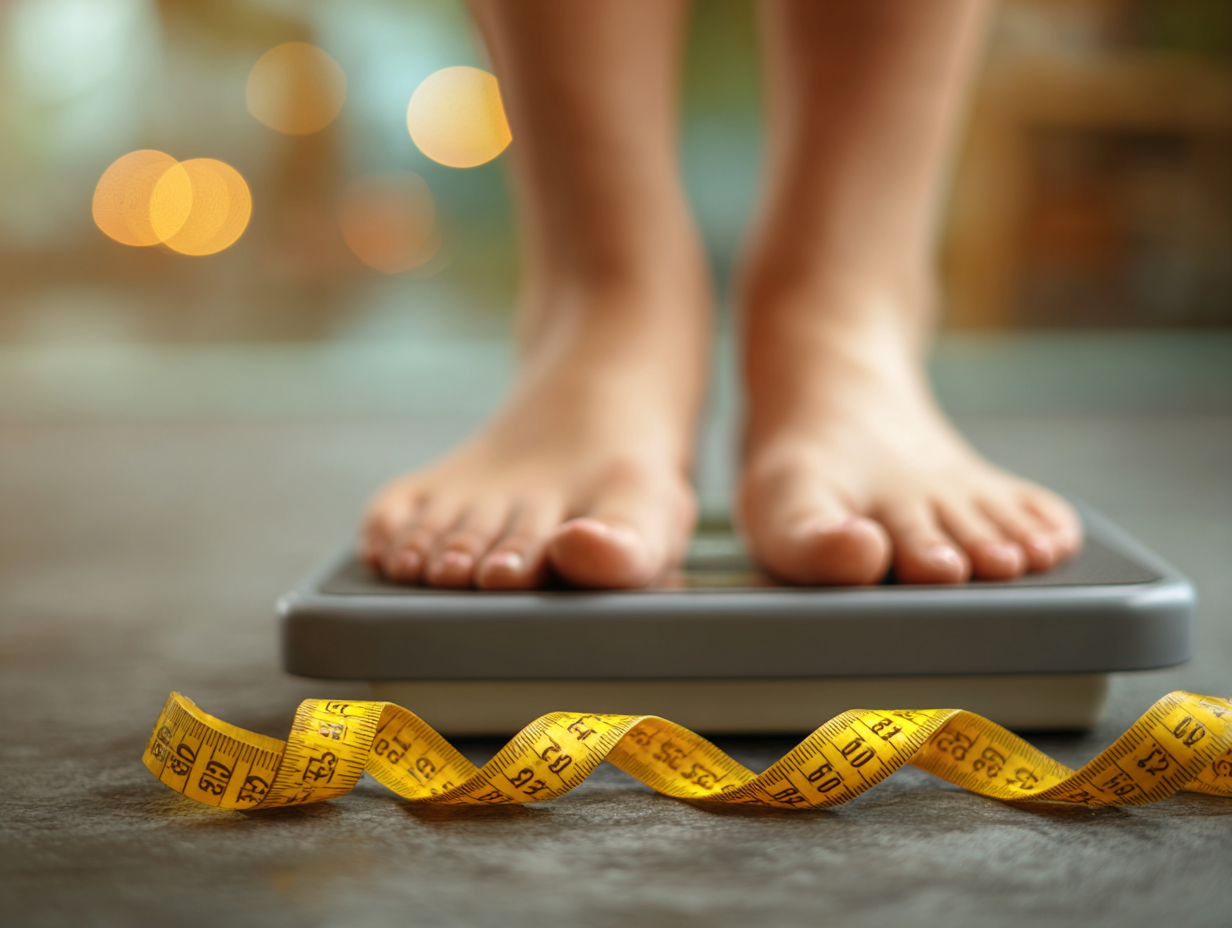
The only meaningful way to track progress is to weigh yourself at the same time every day (morning, after bathroom, before eating) and look at the weekly average — not the daily number. Over a 2–4 week period, the trend is what matters. If the weekly average is moving down by 0.2–0.5 kg, the deficit is working exactly as it should, regardless of what any individual day’s number says.
If the average hasn’t moved after 3–4 weeks of honest tracking, one of three things is true: the deficit is smaller than you think (tracking isn’t accurate), your maintenance calories are lower than calculated (possible, especially with a history of dieting), or activity has dropped to compensate (your body’s NEAT suppression is real). The response is a small adjustment — reduce by 100–150 calories, or add 1,000–2,000 daily steps — not a dramatic overhaul.

Calorie deficit for women: a few things that are different
Most of the calorie deficit research was historically done on men. The picture for women is more nuanced — not more complicated, just different in ways worth knowing.
Your calorie needs change through your cycle. In the two weeks before your period (the luteal phase), your resting metabolism is measurably higher — studies estimate by 100–300 extra calories per day. This is why hunger increases in the week before your period. It’s not cravings or emotional eating — your body is burning more energy and accurately signalling that it needs more fuel. Being slightly more flexible with calories during this phase, rather than rigidly sticking to a deficit, often produces better long-term results because you’re working with your biology rather than against it.
Women are more sensitive to very low calorie intake. When calories drop below a certain threshold, women’s bodies respond more quickly with hormonal disruption — specifically, reduced production of reproductive hormones. The first signs are often subtle: a lighter period, an irregular cycle, increased fatigue, lower libido. These are early warning signals that the deficit is too large. A missed period is not a minor inconvenience — it’s your body shutting down a non-essential system to protect vital functions, and it warrants taking the deficit up immediately.
The floor matters. Most research suggests women shouldn’t go below 1,200 calories per day under any circumstances without medical supervision — and for active women, the practical floor is higher, around 1,400–1,500. Below these numbers, getting adequate protein, iron, calcium, and essential vitamins from food becomes nearly impossible, regardless of how carefully you choose what to eat.

The easiest way to find your deficit — and get a meal plan to match
The fastest way to put all of this into practice is to use SmartBite Balance — a free iOS app that does the calculation for you and takes it several steps further.
Here’s how it works: you enter your age, weight, height, activity level, and goal — lose weight, maintain, or build muscle. SmartBite calculates your personal daily calorie target, applies the right deficit for your goal, and immediately generates a full day of meals — breakfast, lunch, dinner, and a snack — balanced to your exact numbers. Not a generic internet plan. A plan built around your body and your goal specifically.
Don’t like one of the meals? Tap to swap it. The new meal still hits your numbers — the deficit stays intact automatically. Every menu also generates a ready-made shopping list so you know exactly what to buy.
No account. No email. No logging what you already ate. You just know what to eat before your day starts.
For a full breakdown of how movement, sleep, stress, and hydration work alongside the deficit, our article on 5 steps to lose weight covers all of it — the deficit is Step 1, but the other four steps determine how well it works.
For a full breakdown of how movement, sleep, stress, and hydration work alongside a deficit to accelerate results, our article on 5 steps to lose weight covers the complete picture — the deficit is Step 1, but the other four steps determine how well it works.
The takeaway
A calorie deficit for women doesn’t have to mean being hungry, exhausted, and obsessed with food. That experience is almost always a sign that the deficit is too large — not that the approach is wrong.
A moderate deficit of 200–500 calories below maintenance, built around high-protein meals and foods that actually fill you up, is sustainable in a way that crash diets never are. It’s slower. It’s less dramatic. And it works — not just for 30 days, but for as long as you keep doing it.
The number is the starting point. What you do with it — what you eat, how you move, how you sleep — determines everything else.
Sources
- Frankenfield D, et al. Comparison of Predictive Equations for Resting Metabolic Rate in Healthy Nonobese and Obese Adults: A Systematic Review. Journal of the American Dietetic Association, 2005. pubmed.ncbi.nlm.nih.gov
- Nedeltcheva AV, et al. Insufficient sleep undermines dietary efforts to reduce adiposity. Annals of Internal Medicine, 2010. pubmed.ncbi.nlm.nih.gov
- Leibel RL, et al. Changes in Energy Expenditure Resulting from Altered Body Weight. New England Journal of Medicine, 1995. pubmed.ncbi.nlm.nih.gov
- Fothergill E, et al. Persistent metabolic adaptation 6 years after “The Biggest Loser” competition. Obesity, 2016. pubmed.ncbi.nlm.nih.gov
- Morton RW, et al. A systematic review, meta-analysis and meta-regression of the effect of protein supplementation on resistance training-induced gains in muscle mass and strength. British Journal of Sports Medicine, 2018. pubmed.ncbi.nlm.nih.gov
- Leidy HJ, et al. The role of protein in weight loss and maintenance. American Journal of Clinical Nutrition, 2015. pubmed.ncbi.nlm.nih.gov
- Stiegler P, Cunliffe A. The Role of Diet and Exercise for the Maintenance of Fat-Free Mass and Resting Metabolic Rate During Weight Loss. Sports Medicine, 2006. pubmed.ncbi.nlm.nih.gov
- Solomon SJ, et al. Menstrual cycle and basal metabolic rate in women. American Journal of Clinical Nutrition, 1982. pubmed.ncbi.nlm.nih.gov
- Loucks AB. Energy balance and body composition in sports and exercise. Journal of Sports Sciences, 2004. pubmed.ncbi.nlm.nih.gov
- Rolls BJ. The relationship between dietary energy density and energy intake. Physiology & Behavior, 2009. pubmed.ncbi.nlm.nih.gov
- Pontzer H, et al. Daily energy expenditure through the human life course. Science, 2021. pubmed.ncbi.nlm.nih.gov
This article is for informational purposes only and is not a substitute for professional medical or nutritional advice. If you have concerns about your weight, metabolism, or eating habits, please consult a qualified healthcare provider or registered dietitian for a personal assessment.