

You don’t slouch on purpose. Nobody does. But by the time you notice the tight shoulder, the dull lower-back ache, or the neck that just won’t unknot, the damage has already been quietly accumulating for months — sometimes years.
Here’s the strange part. Most of the things destroying your posture aren’t dramatic. They’re not falls or injuries or accidents. They’re the small, invisible habits you repeat hundreds of times a day without ever questioning them. The bag you grab on autopilot. The way you sit at your desk. The phone you check fifty times before lunch.
Your body is endlessly patient. It adapts to everything you ask of it. And eventually, it stops being able to undo those adaptations.
So let’s talk about the everyday culprits — the ones science has actually studied — and what’s really happening inside your body when you do them.

1. The bag you carry on the same shoulder every single day
You grab it without thinking. Same shoulder. Same side. Every morning.
Here’s what your body has to do to keep you upright while carrying that asymmetric weight: your spine bends away from the load, your shoulder on the loaded side rises, your pelvis tilts, and your trunk muscles on one side fire harder than the other to keep you balanced. Over time, the muscles on one side shorten and tighten while the opposite side stretches and weakens.
Research has shown that carrying a bag on one shoulder produces measurably greater stress on the lumbar spine than a backpack — and once the bag’s weight exceeds 10% of your body weight, the asymmetry becomes significant enough to alter your gait and posture. Heavier handbags (above 15% of body weight) increase lumbar disc stress exponentially.
The fix: Switch shoulders constantly. Better yet, use a backpack with both straps, or a crossbody bag where the strap distributes weight diagonally across your torso. And empty your bag — most of what’s in there isn’t earning its space.
2. Your bra doesn’t actually fit (and you have no idea)
This one surprises a lot of women. Studies have repeatedly found that between 70% and 100% of women wear the wrong bra size — even after a professional fitting.
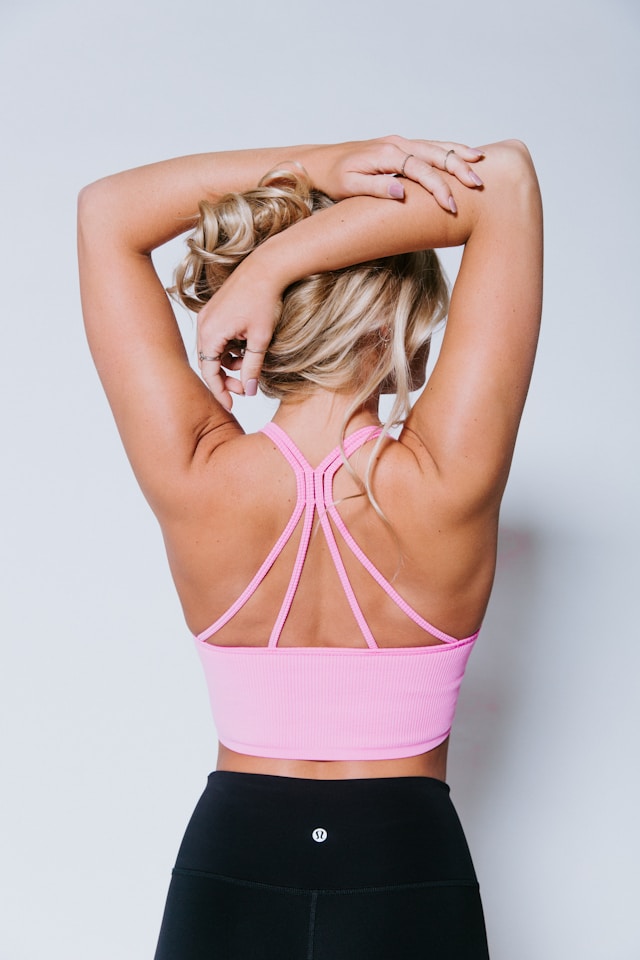
Here’s why it matters for your posture. When the band is too loose, the shoulder straps end up carrying weight they were never designed to hold. The straps were meant to position the bra, not support breast weight. When they’re forced into a support role, they pull your shoulders forward and down, compressing the muscles around your collarbone and upper back. Over time, the trapezius muscles on top of your shoulders develop chronic tension, the chest muscles tighten, the upper back weakens, and your posture quietly collapses inward.
For women with larger breasts, the effect is amplified. Research shows that inadequate breast support during movement can increase spinal loading by up to 56%. That’s not a small number. It builds up across every step you take, every hour of every day.
The fix: Get professionally fitted — and don’t trust a single fitting. Bras stretch over time and your size changes with weight, age, and hormones. The band, not the straps, should carry about 80% of the support. If you’re constantly tugging your straps up, the band is too loose.
3. Sitting at your desk for hours without moving
You knew this one was coming. But it’s not just that you sit — it’s how you sit, and for how long.
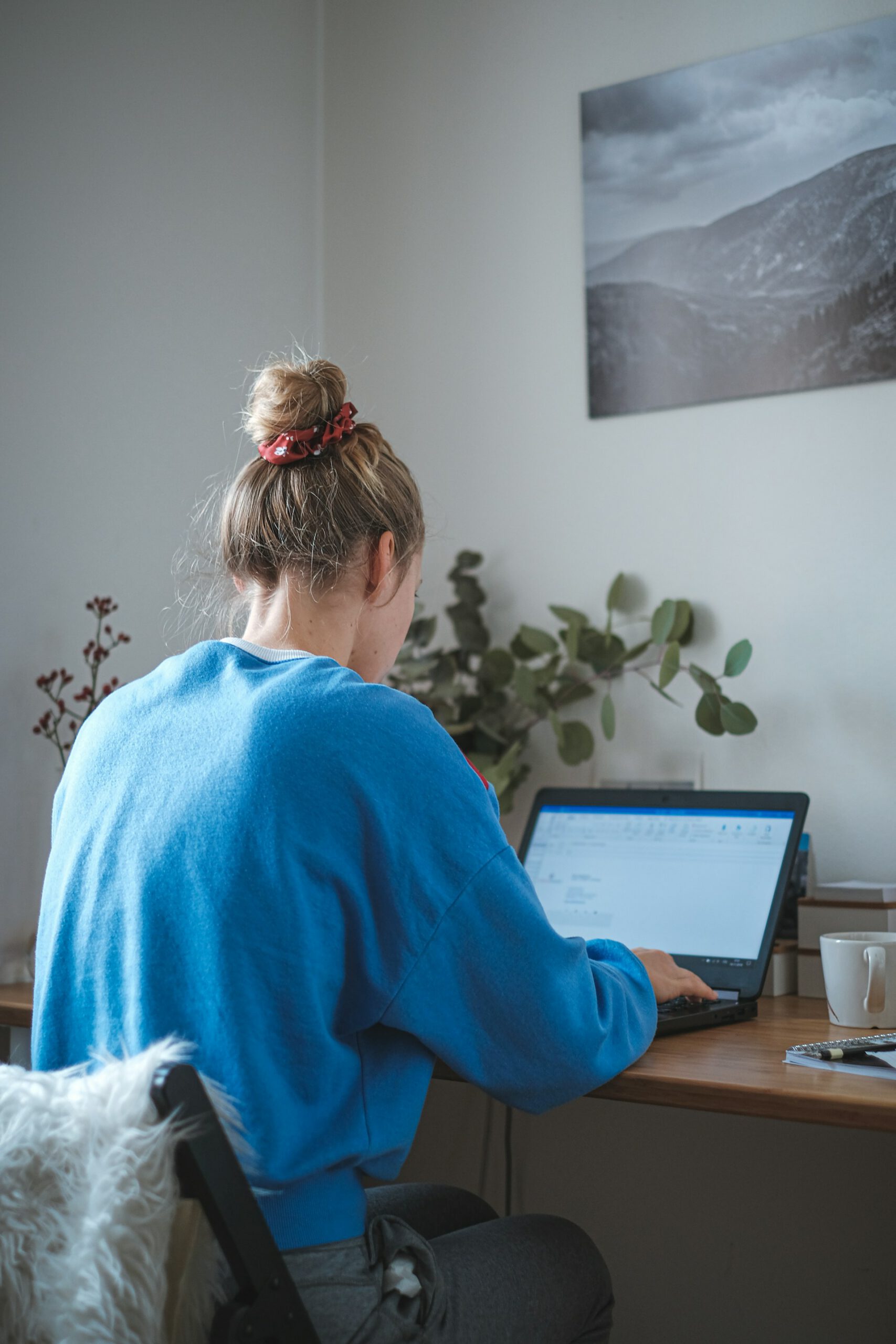
When you sit, your pelvis tilts backward, your lumbar curve flattens, your thoracic spine rounds forward, and your head drifts ahead of your shoulders to compensate. The longer you hold that shape, the more your body treats it as the new default. Hip flexors shorten. Glutes deactivate (a real phenomenon clinicians call “gluteal amnesia”). Core stabilizers weaken. The disks in your lower spine compress.
The research is consistent: people who sit for more than half their workday have a significantly higher risk of low back pain. Office workers spend 70–80% of working hours sitting, and that sustained load on the spine adds up to real structural change.
The fix: Stand up every 30 minutes. Even briefly. Walk to the kitchen, stretch, do anything that’s not sitting. A standing desk helps, but so does a phone reminder. The best posture isn’t a perfect one — it’s a changing one.

4. Looking down at your phone (yes, really)
Your head weighs about 10–12 pounds in a neutral position. When you tilt it forward to look at your phone, the effective weight your neck has to support increases dramatically — by some estimates, up to 60 pounds at a 60-degree angle.
But here’s the more interesting finding from recent studies: it’s not just the weight. Repetitive forward-flexed neck postures from smartphone use have been shown to flatten the natural curve of the cervical spine and shift mechanical load onto vertebrae and muscles that weren’t designed to bear it. The greatest flexion happens at the very top of the neck, where small joints get overloaded thousands of times a day.
The result is what’s now commonly called “tech neck” — chronic neck and shoulder pain, headaches, stiffness, and over time, structural changes in the cervical spine.
The fix: Bring the phone to eye level instead of dropping your head to it. Take breaks. Move your head — turn it, tilt it, roll it — every few minutes. Limit continuous scrolling sessions to 15–30 minutes.

5. Crossing your legs while you sit
It feels comfortable. It’s a small habit. It seems harmless. But research tells a different story.
When you sit with one leg crossed over the other, your pelvis tilts asymmetrically, one side of your trunk shortens, your spine rotates slightly, and your weight shifts unevenly into one buttock. Hold that position for hours every day, and the asymmetry starts to set into your tissues.
A study tracking adults who crossed their legs for three or more hours a day found measurable shoulder inclination, pelvic tilt, and forward head posture compared to people who didn’t. Another study found that prolonged cross-legged sitting causes posterior rotation of one side of the pelvis and creates a concavity-convexity pattern in the spine — basically, a mild functional scoliosis from habit alone.
The fix: Notice when you do it. Aim to sit with both feet flat on the floor. If you must cross, switch sides constantly — and don’t make any single position last more than a few minutes.

6. High heels, more often than your feet can handle
This one is more complicated than the headlines suggest. The popular claim — that high heels increase the curve of your lower back and that’s what causes pain — actually isn’t well supported by research. Several studies have found heels either don’t change lumbar lordosis or actually decrease it slightly.
But that doesn’t mean heels are off the hook. What heels do change is the position of your pelvis, the alignment of your knees, the loading patterns through your ankles, and the activation of your calf muscles. They shift your center of gravity forward, force your knees and ankles into compensation, and over time can shorten the calf muscles and Achilles tendon. Up to 58% of regular high-heel wearers report low back pain — even if the cause isn’t increased lordosis specifically, the cumulative biomechanical compensation is real.
The fix: Reserve heels for special occasions, not daily wear. When you do wear them, keep walking distances short. Stretch your calves and ankles regularly. And alternate with flat, supportive shoes whenever possible.

7. Sleeping in a position your spine doesn’t agree with
Sleeping on your stomach forces your neck to rotate to one side for hours at a time. Sleeping on your back with no neck support flattens your cervical curve. Sleeping on your side with a pillow that’s too thin or too thick collapses your shoulder or jacks your head out of alignment with your spine.
You spend about a third of your life in whatever position you sleep. That’s a lot of hours for your body to “learn” a misalignment.
The fix: Side sleeping with a pillow that keeps your head level with your spine is generally the safest bet. Avoid stomach sleeping if you can. If you sleep on your back, use a thinner pillow that supports your neck without pushing your head forward.

8. Using only one hand to text or scroll
Most of us text with one hand — usually the dominant one. The other shoulder drops, the texting arm tenses, and your head tilts toward the screen at a slight angle. Repeat that thousands of times a week and you’ve trained an asymmetry into your upper body.
Studies have specifically found that one-handed (unilateral) texting is associated with more neck and shoulder pain than two-handed texting. The asymmetric muscle activation pattern doesn’t get a chance to balance out.
The fix: Use both hands when you can. Switch the hand you scroll with. Better yet, prop the phone up so neither hand has to do all the work.
9. Holding tension in your shoulders without realizing it
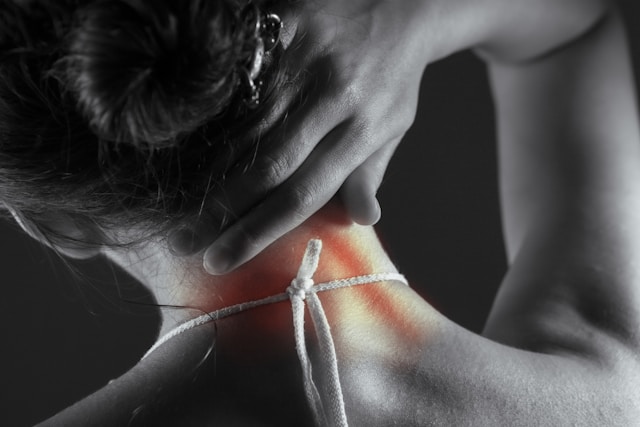
Right now, where are your shoulders? Probably pulled up toward your ears. Most of us walk around with our trapezius muscles silently contracted — bracing against stress, against cold, against nothing in particular. It just becomes habit.
Chronic shoulder elevation from stress and poor postural awareness keeps the upper trapezius and levator scapulae muscles in a permanent state of low-level contraction. They never fully relax. Eventually, they stop being able to. The shoulders sit higher than they should, the neck tightens, and the whole upper-body posture compresses.
The fix: Several times a day, do a “shoulder reset” — pull your shoulders up to your ears, hold for two seconds, then drop them as low as they’ll go. Take a breath. Notice the difference. That’s where your shoulders are supposed to live.
The bigger picture
None of these habits are catastrophic on their own. That’s exactly the problem. They feel normal because they are normal — until one day you notice your neck won’t turn the way it used to, or your lower back hurts when you stand up, or your shoulders won’t drop no matter how hard you try.
Posture isn’t something you fix with one stretch or one expensive ergonomic chair. It’s something you build — or lose — through the small things you do every single day. The bag. The chair. The phone. The pillow. The shoes.
The good news? Your body is just as capable of unlearning these patterns as it was of learning them. Awareness is where it starts. Every time you catch yourself doing one of these things and gently shift, you’re giving your body permission to find a better default.
Start with one. Not all nine. Just one — the one that hit hardest while you were reading.
Your spine is going to thank you in twenty years.
Sources
- Haworth L, May K, Janssen J, Selfe J, Chohan A. The impact of breast support garments on fit, support and posture of larger breasted women. Applied Ergonomics. 2022. — https://pubmed.ncbi.nlm.nih.gov/35151120/
- Chohan A, et al. Does an alternative breast support garment provide symptomatic relief for larger breasted women with chronic non-specific back pain? PMC. — https://pmc.ncbi.nlm.nih.gov/articles/PMC11005674/
- A novel multi-study intervention investigating the short and long term effects of a posture bra on whole body and breast kinematics. PubMed. — https://pubmed.ncbi.nlm.nih.gov/33161276/
- Wood K, Cameron M, Fitzgerald K. Breast size, bra fit and thoracic pain in young women: a correlational study. PMC. — https://pmc.ncbi.nlm.nih.gov/articles/PMC3704920/
- Liu Y, et al. The Biomechanical Effects of Different Bag‐Carrying Styles on Lumbar Spine and Paraspinal Muscles: A Combined Musculoskeletal and Finite Element Study. PMC. — https://pmc.ncbi.nlm.nih.gov/articles/PMC9837261/
- Effects of Same-Sided and Cross-Body Load Carrying on the Activity of the Upper Trapezius and Erector Spinae Muscles. J Musculoskelet Sci Technol. — https://www.jkema.org/archive/view_article?pid=jkema-1-1-2
- The effect of frontpacks, shoulder bags and handheld bags on 3D back shape and posture in young university students. PubMed. — https://pubmed.ncbi.nlm.nih.gov/22744472/
- David D, Giannini C, Chiarelli F, Mohn A. Text Neck Syndrome: Disentangling a New Epidemic. PMC. — https://pmc.ncbi.nlm.nih.gov/articles/PMC9982850/
- The effect of smartphone texting on cervical spine sagittal alignment in healthy young adults. PMC. — https://pmc.ncbi.nlm.nih.gov/articles/PMC12775622/
- Cleveland Clinic. Are Your Screens a Pain in the ‘Tech Neck’? — https://health.clevelandclinic.org/tech-neck
- Kinematic Analysis of the Forward Head Posture Associated with Smartphone Use. MDPI. — https://www.mdpi.com/2073-8994/15/3/667
- Adverse Effects of Prolonged Sitting Behavior on the General Health of Office Workers. PMC. — https://pmc.ncbi.nlm.nih.gov/articles/PMC5618737/
- Association between sitting and occupational LBP. European Spine Journal, PMC. — https://pmc.ncbi.nlm.nih.gov/articles/PMC2200681/
- Yale Medicine. Why Is Sitting so Bad for Us? — https://www.yalemedicine.org/news/sitting-health-risks
- UCLA Health Spine Center. Ergonomic and Proper Posture for Sitting. — https://www.uclahealth.org/medical-services/spine/patient-resources/ergonomics-prolonged-sitting
- Ahn S, Kim S, Kang S, et al. Asymmetrical change in the pelvis and the spine during cross-legged sitting postures. Journal of Mechanical Science and Technology. — https://link.springer.com/article/10.1007/s12206-013-0865-5
- Comparison of Postures According to Sitting Time with the Leg Crossed. PMC. — https://pmc.ncbi.nlm.nih.gov/articles/PMC4242947/
- The effects of sitting with the right leg crossed on the trunk length and pelvic torsion of healthy individuals. PMC. — https://pmc.ncbi.nlm.nih.gov/articles/PMC5140821/
- Immediate Effect of Simulated High Heels on Pelvic and Spinal Posture in Healthy Young Subjects. PMC. — https://pmc.ncbi.nlm.nih.gov/articles/PMC10994651/
- Baaklini E, et al. High-heeled walking decreases lumbar lordosis. Gait & Posture, PubMed. — https://pubmed.ncbi.nlm.nih.gov/28407504/
- The effect of high-heeled shoes on lumbar lordosis: a narrative review. Journal of Chiropractic Medicine, PMC. — https://pmc.ncbi.nlm.nih.gov/articles/PMC3206568/
This article is intended for educational purposes and is based on peer-reviewed research and information from medical institutions. It is not a substitute for personalized medical advice. If you experience persistent pain or postural problems, consult a qualified healthcare professional.