


If you’ve ever lost weight and gained it back, you already know the hardest part of weight loss isn’t losing it — it’s keeping it off. Most people who lose 20 pounds on a diet have gained it all back within a year or two. A lot of them end up heavier than where they started.
So here’s the real question, and the one this article is going to answer: how to lose weight and keep it off, according to people who’ve actually done it. Not influencers. Not a 21-day miracle plan. Not a supplement. Real people, tracked for years, by actual researchers.
The good news: the science is extremely clear on what works. The bad news: it’s not sexy. Nobody can sell it to you in a bottle. But if you follow what the research actually shows, your odds go up dramatically.
The one study everyone trying to lose weight should know about
In 1994, two researchers — Dr. Rena Wing at Brown University and Dr. James Hill at the University of Colorado — started a project called the National Weight Control Registry (NWCR). Their goal was simple: find people who had actually lost a significant amount of weight and kept it off, then study what those people had in common.
To qualify for the registry, you have to have lost at least 30 pounds and kept it off for at least one year. Today, the NWCR has over 10,000 members. The average member lost 66 pounds and has kept it off for 5.5 years. Some have kept it off for decades.
This is the single most valuable dataset in weight loss science. It’s not a theoretical study of what might work — it’s a real-world database of what actually worked for thousands of people over years. And the patterns are remarkably consistent.
Here’s what those successful people have in common.

Rule 1: Create a small calorie deficit — not a huge one
Every weight loss plan that has ever worked, for anyone, ever, comes down to the same thing: eating slightly less energy than your body uses. There is no exception to this. Low-carb, keto, intermittent fasting, Mediterranean, Weight Watchers — they’re all just different ways to accomplish the same goal. When any of them work, it’s because they got you into a calorie deficit. When none of them work, it’s because they didn’t.
But here’s the key word: small. The CDC, the NIH, and the Mayo Clinic all recommend the same target: 1 to 2 pounds per week. That’s it. That’s the whole rate. For most people, this means eating roughly 300–500 calories per day less than you burn.
Why so slow? Because faster isn’t actually faster — it’s shorter. Crash diets cause your body to burn muscle alongside fat, slow your metabolism for years afterward, and set you up to regain more weight than you lost. I wrote about this in detail in 6 weight loss myths the fitness industry sells you — the Biggest Loser study found that contestants had permanently damaged metabolisms six years after the show. That’s what aggressive calorie restriction does.
A moderate deficit, on the other hand, preserves your muscle, doesn’t trigger starvation mode, and leads to the kind of weight loss you can actually maintain. The NWCR confirms this: the people who keep weight off long-term almost never lost it at extreme rates.

Rule 2: Move your body every day (and it doesn’t have to be the gym)
Here’s a statistic that might surprise you: 94% of people in the National Weight Control Registry say physical activity was a key part of how they lost weight, and 90% still exercise to keep it off. And the most common form of exercise they report? Not running. Not CrossFit. Not HIIT.
Walking.
On average, NWCR members burn about 2,600 calories per week through physical activity — roughly the equivalent of walking about an hour a day. But there’s a huge range in that number. About 25% of members maintain their weight loss with relatively low amounts of activity. The other 75% are more active. What unites all of them is consistency.
A major 2025 study in JAMA Network Open followed more than 11,000 adults for four years and found that people who walked more than 100 minutes a day had a 23% lower risk of developing chronic low back pain — and walking was associated with better weight management at any intensity. I covered the full walking research in how to prevent back pain: 7 proven daily habits.
You don’t need a gym membership. You don’t need fancy shoes. You need 30–60 minutes a day of moving your body in some way you can actually stick with. Walking. Swimming. Cycling. Dancing in your kitchen. It all counts.

Rule 3: Eat the same way on weekends as on weekdays
This one is weirdly specific but the research is strong. NWCR members are notable for maintaining a consistent eating pattern across the entire week. They don’t dramatically restrict on Monday through Friday and then “treat themselves” all weekend. One study found that people who ate consistently across all seven days were 1.5 times more likely to maintain their weight loss than people who had one relaxed eating pattern on weekdays and a different one on weekends.
Why? Because “cheat weekends” can wipe out an entire week of calorie deficit in two days. If you spent Monday through Friday in a 500-calorie deficit (saving 2,500 calories) and then ate 1,500 calories over your maintenance on Saturday and Sunday, you ended the week 500 calories ahead of where you started. That’s how people plateau and don’t understand why.
This doesn’t mean you have to eat identical meals every day forever. It means your overall pattern — how much, what kinds of foods, how often — should look roughly similar on Sunday as it does on Tuesday. Flexibility is fine. Chaos isn’t.

Rule 4: Focus on protein and whole foods, not “good” and “bad” foods
The NWCR data is clear that successful losers don’t follow extreme diets. Only about 7% eat a strict low-carb diet. Basically nobody eats keto. Most eat a relatively balanced diet — moderate carbs, moderate fat, and higher protein than the average American.
Here’s why protein matters so much for weight loss:
- Protein keeps you full. Gram for gram, protein is more satiating than carbs or fat. People who eat adequate protein naturally eat fewer calories without trying.
- Protein protects muscle during weight loss. When you’re in a calorie deficit, your body will burn some muscle along with fat unless you give it a reason not to. Adequate protein (plus some resistance training) gives it that reason.
- Protein has a higher “thermic effect.” Your body burns more calories digesting protein than it does digesting carbs or fat — about 20–30% of the calories in protein are used just to process it.
A good target for most adults trying to lose weight is 0.7–1 gram of protein per pound of target body weight (or roughly 1.6–2.2 g/kg). For a 150-pound person, that’s around 100–150 grams of protein per day. Eggs, chicken, fish, Greek yogurt, cottage cheese, lean beef, tofu, lentils, protein powder — all good sources.
As for the rest of your diet: prioritize whole foods. Vegetables, fruit, whole grains, beans, nuts, olive oil. The Harvard School of Public Health’s recommendation is simple — fill half your plate with vegetables and fruit, a quarter with whole grains, and a quarter with protein. You don’t have to count macros. You don’t have to label foods “good” or “bad.” Just aim for that plate most of the time.
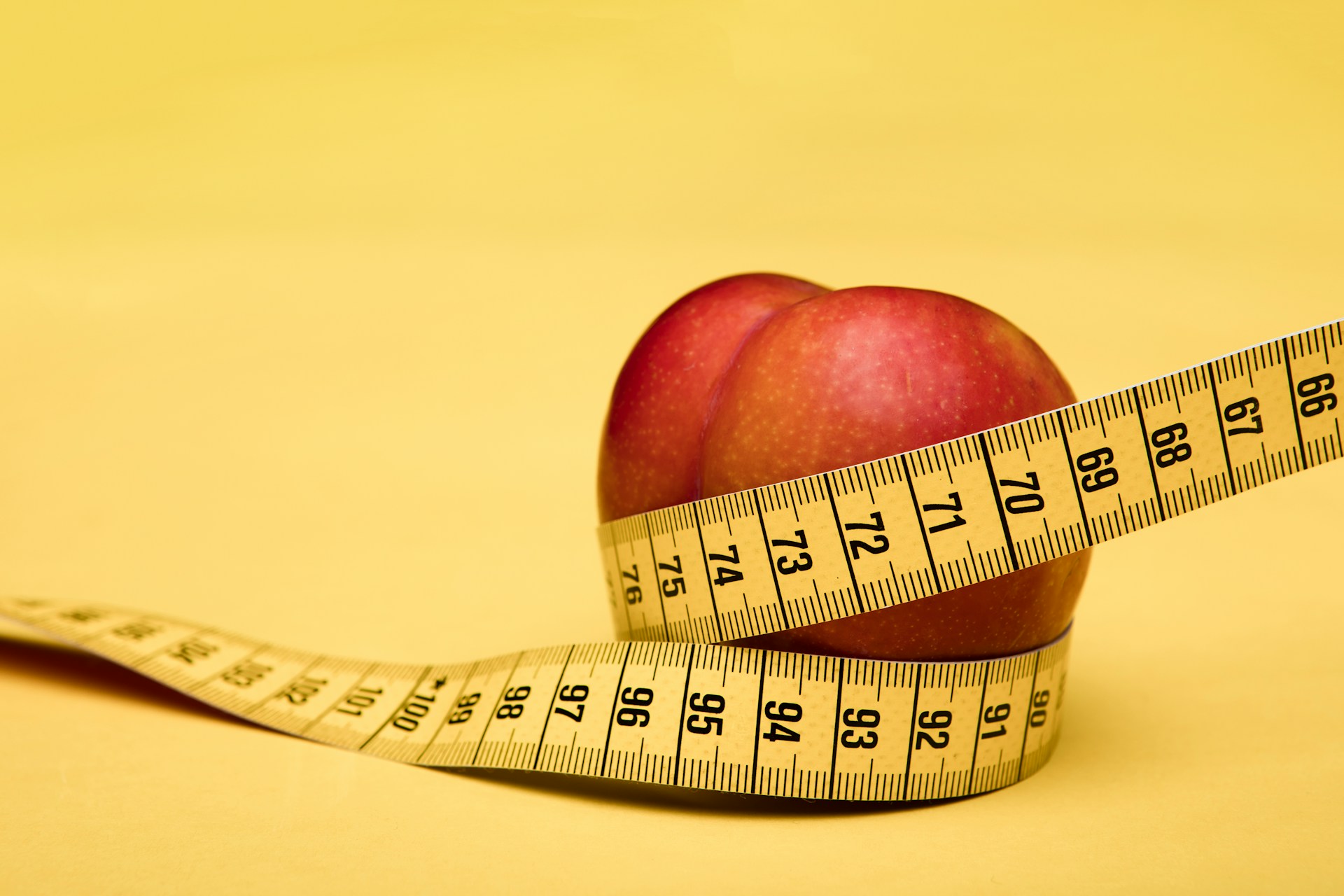
Rule 5: Track body measurements, not just the scale
Here’s something most weight loss advice gets wrong: the scale is a lousy tool for measuring fat loss. A pound of muscle and a pound of fat weigh the same — but muscle is about 18% denser, meaning it takes up much less space in your body. Someone who loses 5 pounds of fat and gains 3 pounds of muscle through strength training looks dramatically different in the mirror, but the scale only moved 2 pounds. That’s misleading at best and demoralizing at worst.
This is why successful long-term weight losers pay more attention to body measurements than to the scale alone. A measuring tape costs $3 and tells you what the scale can’t: where you’re actually losing fat.
Take these four measurements once a week (or every two weeks), first thing in the morning, before eating:
- Waist — measure at the narrowest point, usually just above the belly button. This is the most important one for health, because abdominal fat is the most metabolically dangerous type.
- Hips — measure at the widest point around your buttocks.
- Chest — across the fullest part.
- Thighs — at the widest point, usually just below the hip crease.
Write them down. Track them over time. You’ll often see inches drop from your waist even in weeks when the scale didn’t move — that’s fat loss your scale couldn’t see.
Other ways to track progress that are more honest than weight alone:
- How your clothes fit. A pair of jeans that used to be tight and now buttons easily is a better signal than any number.
- Progress photos. Take them once a month, same lighting, same pose, same clothes. Changes are hard to see day-to-day but obvious across 60 days.
- Energy levels, sleep quality, and how you feel. These matter more than any data point.
- Strength in the gym. If you’re lifting more weight or doing more reps than a month ago, your body is changing in the right direction even if the scale hasn’t.
Where the scale still fits in: use it as one data point, not the only one. Weighing yourself once a week (same day, same time, after using the bathroom, before eating or drinking) can help you catch long-term trends. 75% of NWCR members weigh themselves at least weekly, and research published in Obesity found that regular self-weighing was associated with better weight maintenance. But the key word is trends — your weight can fluctuate 2–5 pounds in a single day from water, sodium, hormones, and digestion. Don’t panic about daily numbers. Look at the monthly average.
The caveat: if you have a history of eating disorders or find that the scale or measurements trigger anxiety, restrictive eating, or unhealthy thoughts, skip the numbers entirely. Use clothes, photos, and how you feel instead. Your mental health matters more than any data point.

Rule 6: Sleep 7–9 hours a night
You cannot out-diet bad sleep. This is one of the most underrated facts in weight loss.
When you’re sleep-deprived, two things happen to your hunger hormones: ghrelin (the hormone that makes you hungry) goes up, and leptin (the hormone that makes you feel full) goes down. The combination makes you hungrier, less satisfied by food, and drawn to high-calorie, high-carb foods specifically. A 2022 study in JAMA Internal Medicine found that adults who were sleep-restricted to 6 hours a night ate an average of 270 more calories per day than adults sleeping 8+ hours — without realizing it.
Beyond hormones, lack of sleep damages your willpower, reduces your motivation to exercise, and increases cortisol (a stress hormone linked to belly fat storage).
If you’re trying to lose weight and sleeping 5–6 hours a night, fixing your sleep is probably the single highest-leverage thing you can do. Consistent bedtime. Dark room. No screens in bed. Seven to nine hours. Boring and effective.

Rule 7: Eat slowly enough to feel full
Your stomach fills up faster than your brain finds out about it. It takes roughly 20 minutes for fullness signals to travel from your gut to your brain. If you inhale a meal in 10 minutes, you’ll overeat by hundreds of calories before you even feel satisfied.
Studies have found that slow eaters consume about 10% fewer calories per meal and feel more full doing it. A huge study of nearly 60,000 adults in Japan found that slow eaters were 42% less likely to be obese than fast eaters. I covered the practical technique for slowing down in the fork rule: a simple habit that helps you eat less — put the fork down between every bite. That’s the whole trick.
This rule is free, takes zero extra time out of your day (your meal just stretches from 10 minutes to 25), and compounds over thousands of meals across the years.

Rule 8: Aim for 5–10% — not “my college weight”
Here’s one of the most important things the research shows, and almost nobody talks about it. You don’t need to lose a dramatic amount of weight to get dramatic health benefits. The NIH clinical guidelines are explicit: losing just 5–10% of your body weight produces meaningful improvements in blood pressure, cholesterol, blood sugar, joint pain, and risk of type 2 diabetes and heart disease.
For a 200-pound person, that’s 10–20 pounds. Not 60. Not “back to what I weighed in high school.” Just 10–20.
This matters psychologically more than you might think. When people set massive weight loss goals (50, 80, 100 pounds), the goal feels so far away that any small setback feels catastrophic and they give up. When people set smaller, achievable goals, they reach them, feel successful, and build momentum.
Lose 5% first. Celebrate it. Maintain it for a few months. Then decide whether you want to lose another 5%. This is how the most successful NWCR members did it — in stages, not in one heroic push.

Rule 9: Plan for the regain risk (because everyone faces it)
Even in the NWCR — a group of people specifically selected because they’re successful — researchers track who regains weight over time. And they’ve found that the riskiest period is the first two years after reaching your goal weight. People who make it past year two are much more likely to keep the weight off permanently.
The single biggest predictor of regain? Letting your weight-maintenance behaviors slip. People who stopped weighing themselves, stopped walking daily, and drifted back into old eating patterns were the ones who regained. People who kept up the habits — even the small ones — didn’t.
The practical implication: the habits that got you there are the habits that keep you there. There is no “finish line” where you go back to your old life. The new way of eating and moving is the maintenance plan. If this sounds exhausting, it’s actually the opposite — the NWCR found that after two years, maintenance gets significantly easier because the habits become automatic. You stop thinking about them. They’re just how you live now.
What doesn’t work (and what to avoid)
Before we wrap up, a quick honest word on the things that waste your time, money, and motivation. I’ve written longer articles on each of these, but here are the shortcuts to what to skip:
- Detox teas, cleanses, and “fat-burning” supplements. No weight loss value. Some cause real harm. See 6 popular wellness products that don’t work for the research.
- Spot reduction exercises. You cannot target belly fat with crunches or thigh fat with leg lifts. Fat loss happens across the whole body based on genetics and hormones, not which muscle you’re working.
- Waist trainers, cling wrap, ab stimulator belts, and other “flat stomach hacks.” Useless at best, dangerous at worst. See flat stomach hacks that don’t work.
- Extreme crash diets that promise “10 pounds in a week.” That’s water weight, muscle loss, and metabolic damage. You’ll gain it all back, plus more.
- Products that promise you can skip the calorie deficit. None of them work. If one did, there would be no obesity crisis.
The honest bottom line
Here’s the truth nobody selling a weight loss product wants you to hear: how to lose weight and keep it off is not a secret. It’s not buried in a supplement or a special diet or an expensive program. The science has been clear for decades.
Eat slightly less than you burn, mostly from whole foods, with plenty of protein. Move your body every day. Sleep enough. Weigh yourself regularly so you notice problems early. Aim for slow, sustainable progress instead of dramatic results. Expect it to take months, not weeks. And understand that the habits that get you to your goal are the same habits that keep you there.
It’s not exciting. You can’t put it on a T-shirt. But it’s what thousands of real people have actually done. And if you follow it, the odds are strongly in your favor — not of a dramatic transformation in 30 days, but of being in a better place a year from now, and a better place still in two years, and a permanently changed person in five.
That’s what works. That’s what the research shows. That’s how to lose weight and keep it off.
Sources
- National Weight Control Registry. Research findings and member data. Brown University Weight Control & Diabetes Research Center. nwcr.ws
- Klem ML, Wing RR, McGuire MT, et al. A descriptive study of individuals successful at long-term maintenance of substantial weight loss. American Journal of Clinical Nutrition, 1997. pubmed.ncbi.nlm.nih.gov
- Catenacci VA, et al. Physical Activity Patterns in the National Weight Control Registry. Obesity, 2008. pmc.ncbi.nlm.nih.gov
- Centers for Disease Control and Prevention. Losing Weight: Steps for Success. cdc.gov
- Mayo Clinic. Weight loss: 6 strategies for success. mayoclinic.org
- NIH National Institute of Diabetes and Digestive and Kidney Diseases. Choosing a Safe and Successful Weight-Loss Program. niddk.nih.gov
- Clinical Guidelines on the Identification, Evaluation, and Treatment of Overweight and Obesity in Adults. National Heart, Lung, and Blood Institute / NIH. ncbi.nlm.nih.gov
- Haddadj R, et al. Volume and Intensity of Walking and Risk of Chronic Low Back Pain. JAMA Network Open, 2025.
- Hurst Y, Fukuda H. Effects of changes in eating speed on obesity in patients with diabetes. BMJ Open, 2018.
- Harvard T.H. Chan School of Public Health. The Nutrition Source: Healthy Eating Plate. hsph.harvard.edu
- Tasali E, et al. Effect of Sleep Extension on Objectively Assessed Energy Intake Among Adults With Overweight in Real-life Settings. JAMA Internal Medicine, 2022.
This article is for informational purposes only and isn’t a substitute for professional medical advice. If you have a significant amount of weight to lose, a history of eating disorders, or any health condition affecting your weight, please talk to a qualified healthcare provider before starting any weight loss program.